

South Korea Food-Grade Dipotassium Phosphate Market to Reach $166.6M by 2036 with 4.7% CAGR
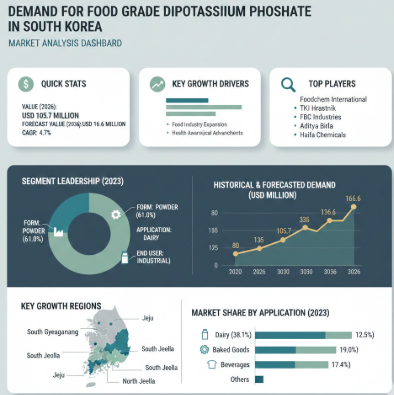
South Korea’s food-grade dipotassium phosphate market is set for steady growth, supported by processed food demand and regulatory quality standards.
NEWARK, DE, UNITED STATES, January 22, 2026 /EINPresswire.com/ -- South Korea’s food-grade dipotassium phosphate market is projected to experience sustained growth over the next decade, supported by expanding food processing activity, evolving dietary preferences, and stringent food safety regulations. A newly published industry analysis provides a detailed forecast for the 2026–2036 period, offering market sizing, segmentation insights, and competitive context relevant to manufacturers, investors, analysts, and food industry stakeholders.
Market Size and Forecast Overview
The analysis estimates that South Korea’s food-grade dipotassium phosphate market will grow from USD 105.7 million in 2026 to USD 166.6 million by 2036, reflecting a compound annual growth rate (CAGR) of 4.7% over the forecast period. Market expansion is primarily driven by the increasing use of functional food additives in dairy, beverage, and processed food applications.
Food-grade dipotassium phosphate is widely used as a buffering agent, emulsifier, and stabilizer, enabling consistency, texture control, and extended shelf life in a range of packaged and processed food products.
Key Market Segmentation Insights
By Form: Powder Segment Leads Demand
Powdered dipotassium phosphate accounts for approximately 61% of total market share, owing to its stability, ease of storage, and compatibility with automated industrial food processing systems.
By Application: Dairy Products Dominate
The dairy segment represents around 38.1% of total consumption, driven by its critical role in processed cheese, milk-based beverages, yogurt, and fortified dairy formulations. The ingredient supports protein stability during heat processing and improves product uniformity.
By End User: Industrial Processors at the Forefront
Large-scale food manufacturers constitute nearly 45% of total demand, reflecting high-volume usage across ready-to-eat meals, beverages, snacks, and functional food products.
Regional and Temporal Scope
The forecast spans 2026 to 2036, with demand concentrated across South Korea’s major food production regions, including Jeju, South Gyeongsang, South Jeolla, and North Jeolla. Jeju’s strong dairy production base contributes significantly to phosphate salt consumption, while mainland industrial zones benefit from advanced logistics infrastructure and export-oriented food manufacturing.
Market Drivers and Industry Context
Processed Food Consumption Trends
Urbanization and changing consumer lifestyles continue to fuel demand for convenience and ready-to-consume food products. Dipotassium phosphate plays a technical role in ensuring product stability and consistency across mass-produced food categories.
Shift Toward Potassium-Based Ingredients
Food manufacturers are increasingly adopting potassium-based additives as alternatives to sodium compounds, aligning with public health initiatives aimed at reducing sodium intake and supporting cardiovascular wellness.
Regulatory Compliance and Food Safety Standards
South Korea’s food safety framework emphasizes strict additive quality, purity, and traceability standards. Compliance requirements encourage food processors to source certified, food-grade phosphate ingredients that meet regulatory thresholds.
Competitive Landscape and Industry Structure
The market features a mix of global chemical producers and specialty ingredient suppliers serving South Korea’s food industry. Key participants focus on quality assurance, supply reliability, and product consistency to meet the needs of industrial food manufacturers.
Innovation efforts within the sector include improvements in product flowability, enhanced solubility, and formulation compatibility with complex food matrices, such as high-protein beverages and dairy alternatives.
Cost Factors and Market Challenges
Despite favorable growth fundamentals, the market remains sensitive to raw material price volatility, particularly for phosphate rock and potassium inputs. Cost management and supply chain optimization remain strategic priorities for manufacturers operating in the region.
Industry Outlook
South Korea’s food-grade dipotassium phosphate market is positioned as a critical component of the country’s advanced food processing ecosystem. Continued innovation, regulatory oversight, and evolving dietary trends are expected to sustain long-term demand, reinforcing the ingredient’s role in modern food manufacturing.
Request for Sample Report | Customize Report |purchase Full Report – https://www.futuremarketinsights.com/reports/sample/rep-gb-31689
Explore More Related Studies Published by FMI Research:
BRIC Performance Coatings Market https://www.futuremarketinsights.com/reports/bric-performance-coatings-market
Polyurethane Resins Paints and Coatings Market https://www.futuremarketinsights.com/reports/global-polyurethane-resins-paints-coatings-market
Perchloroethylene Market https://www.futuremarketinsights.com/reports/global-perchloroethylene-market
About Future Market Insights (FMI)
Future Market Insights, Inc. (FMI) is an ESOMAR-certified, ISO 9001:2015 market research and consulting organization, trusted by Fortune 500 clients and global enterprises. With operations in the U.S., UK, India, and Dubai, FMI provides data-backed insights and strategic intelligence across 30+ industries and 1200 markets worldwide.
Why Choose FMI: https://www.futuremarketinsights.com/why-fmi
Sudip Saha
Future Market Insights Inc.
+1 347-918-3531
rahul.singh@futuremarketinsights.com
Legal Disclaimer:
EIN Presswire provides this news content "as is" without warranty of any kind. We do not accept any responsibility or liability for the accuracy, content, images, videos, licenses, completeness, legality, or reliability of the information contained in this article. If you have any complaints or copyright issues related to this article, kindly contact the author above.
