
Executive Intelligence Report Designer Fiber Market: Disruptions, Drivers & Industry Scenarios
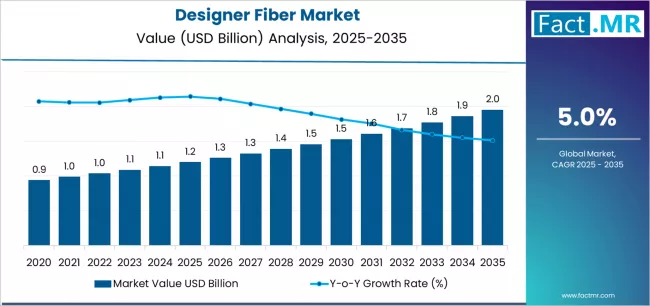
Designer fiber market is projected to grow from USD 1.2 billion in 2025 to USD 2.0 billion by 2035, at a CAGR of 5.0%. Bioengineered will dominate with a 45.0%
ROCKVILLE, MD, UNITED STATES, February 14, 2026 /EINPresswire.com/ -- The global designer fiber market is projected to expand significantly, reaching a valuation of USD 1,950.0 million by 2035, up from USD 1,200.0 million in 2025. This growth represents a steady CAGR of 5.0% over the ten-year forecast period. The industry is being transformed by the rise of bioengineered materials—fibers programmed at a molecular level to outperform traditional silk, collagen, and petroleum-based synthetics.Request for Sample Report | Customize Report | Purchase Full Report – https://www.factmr.com/connectus/sample?flag=S&rep_id=8613
Market size 2025? USD 1,200.0 million.
Market size 2035? USD 1,950.0 million.
CAGR? 5.0% (2025–2035).
Leading type? Bioengineered fibers (capturing 45% of the market).
Leading application? Apparel (accounting for 50% of total market share).
Leading material? Protein-based fibers (synthetic spider silk, collagen).
Key growth regions? India (5.8% CAGR), China (5.3% CAGR), and the USA (4.6% CAGR).
Top companies? Spiber, Bolt Threads, AMSilk, Modern Meadow, Kraig Biocraft, and DuPont.
Market Momentum (YoY Path)
The market is expected to grow by nearly 1.6 times over the next decade:
2025–2030: The market will rise to USD 1,550.0 million. This phase is defined by the luxury fashion sector's adoption of protein-based fibers and early-stage medical integrations.
2030–2035: The market is forecast to reach USD 1,950.0 million. Growth in this period will be driven by specialized medical applications (therapeutic sutures, tissue scaffolds) and industrial-scale manufacturing modernization.
Why the Market is Growing
The designer fiber market enables manufacturers to access high-performance materials without needing massive in-house biotechnology labs.
Superior Performance: Designer fibers typically offer a 40-60% performance enhancement over conventional fibers. For instance, bioengineered silk can exceed the tensile strength of steel while remaining as elastic as rubber.
Sustainability Demands: Brands are under pressure to move away from petroleum-derived synthetics. Designer fibers offer a biodegradable, carbon-neutral alternative produced via precision fermentation.
Government Initiatives: National programs promoting "Advanced Manufacturing" and "Textile Innovation" (particularly in India and China) are providing the regulatory and financial frameworks for adoption.
Segment Spotlight
1) Type: Bioengineered (45% Market Share)
This is the dominant segment, utilizing genetically modified microorganisms (bacteria, yeast, or fungi) to "brew" fibers. These materials are prized for their extreme durability, moisture management, and natural flame resistance.
2) Application: Apparel (50% Market Share)
The apparel sector is the primary driver of demand. Luxury and athletic wear brands use designer fibers to create ultra-lightweight, antimicrobial, and thermally regulating garments that traditional textiles cannot replicate.
3) Application: Industrial & Medical (50% Combined Share)
Industrial (30%): Focuses on high-performance compounds for manufacturing and specialized formulations.
Medical (20%): A high-value niche utilizing bioresorbable sutures and tissue engineering scaffolds that dissolve predictably within the body.
Regional Growth Outlook (CAGR)
India- 5.8%
China- 5.3%
USA- 4.6%
Germany- 4.4%
South Korea - 4.3%
Competitive Landscape:
The market features a moderate concentration, with the top three players—Spiber, Bolt Threads, and AMSilk—controlling approximately 30-40% of the global share.
Technology Leaders: Firms like Spiber and Bolt Threads leverage advanced fermentation platforms to produce recombinant proteins at scale.
Industrial Giants: Established players like DuPont, Toray, and Teijin are pivoting toward hybrid and synthetic designer fibers to maintain chemical stability for industrial use.
Challengers: Modern Meadow and Kraig Biocraft are gaining ground by specializing in specific niches like bio-fabricated leather and spider silk variants.
Browse Full Report: https://www.factmr.com/report/designer-fiber-market
Purchase Full Report for Detailed Insights
For access to full forecasts, regional breakouts, company share analysis, and emerging trend assessments, you can purchase the complete report here: https://www.factmr.com/checkout/8613
Have a specific Requirements and Need Assistant on Report Pricing or Limited Budget please contact us – sales@factmr.com
To View Related Report :
Fiber-Integrated Fat Mimetics for Dairy Alternatives Market: https://www.factmr.com/report/fiber-integrated-fat-mimetics-for-dairy-alternatives-market
Fiber Blends Market: https://www.factmr.com/report/fiber-blends-market
Fiber Syrup Market: https://www.factmr.com/report/4385/fiber-syrup-market
Fiber Rich Flours Market: https://www.factmr.com/report/3025/fiber-rich-flours-market
S. N. Jha
Fact.MR
+1 628-251-1583
email us here
Legal Disclaimer:
EIN Presswire provides this news content "as is" without warranty of any kind. We do not accept any responsibility or liability for the accuracy, content, images, videos, licenses, completeness, legality, or reliability of the information contained in this article. If you have any complaints or copyright issues related to this article, kindly contact the author above.
