

Audio Codec Market Revenue to Triple by 2035 with 5.68% CAGR
Audio Codec Market
Audio Codec Market Size, Share and Research Report By Component (Hardware DSP IP Cores, Software Codec Frameworks), By Codec Type (AAC, aptX Variants, SBC
Audio Codec Market is driving high-quality audio compression and transmission solutions that support seamless communication, streaming, and multimedia experiences.”
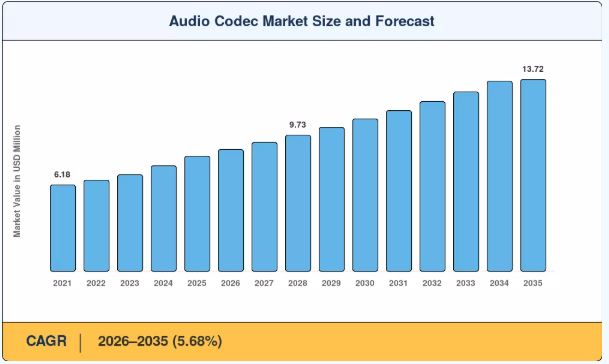
TOKYO, TOKYO, JAPAN, June 19, 2026 /EINPresswire.com/ -- The Global audio codec market reached an estimated USD 8.24 billion in 2025 and is projected to grow from USD 8.70 billion in 2026 to USD 13.72 billion by 2035, registering a CAGR of 5.68% during the forecast period. — Market Research Future (MRFR)
Two major catalysts are driving this trajectory the explosive proliferation of wireless audio devices where global true wireless stereo (TWS) earbuds shipments surpassed 310 million units in 2024 alone and the rapid adoption of high-resolution, low-latency audio standards across streaming, gaming, automotive infotainment, and professional broadcast applications. With audio codec integrated circuits and software stacks now embedded in virtually every connected consumer electronics device, smart home system, and vehicle, the market occupies a foundational role in the global semiconductor and digital media ecosystem.
Legacy compression standards such as MP3 and AAC are giving way to a new generation of perceptually lossless, AI-enhanced codecs capable of delivering studio-quality audio at dramatically reduced bitrates across constrained wireless and cellular networks. A recent ABI Research report estimated that next-generation codec deployments including aptX Lossless, LC3, and LDAC have reduced perceived audio degradation by 40–55% in streaming and wireless audio applications compared with prior-generation standards. This compression technology evolution is not incremental it reflects a fundamental re-architecture of how audio is encoded, transmitted, decoded, and rendered across the full consumer and professional device ecosystem.
Get Full PDF Sample Copy of Report: (Including Full TOC, List of Tables & Figures, Chart) @
https://www.marketresearchfuture.com/sample_request/32761
✿ How Significant Is the Audio Codec Market’s Growth?
The audio codec market has demonstrated robust and sustained expansion, rising from approximately USD 6.93 billion in 2021 to an estimated USD 8.24 billion in 2025, reflecting a healthy historical growth trajectory underpinned by surging consumer demand for wireless audio, rapid growth in voice-enabled smart devices, and the accelerating transition to Bluetooth 5.x and LE Audio standards that are reshaping the codec IP and chip landscape. The market is poised to more than double over the next decade, driven by the proliferation of spatial audio experiences, AI-powered noise cancellation and voice enhancement, and the embedding of advanced audio processing capabilities across automotive, healthcare, and industrial IoT applications.
Rising consumer expectations for lossless wireless audio fueled by the success of Apple’s AirPods Pro spatial audio capabilities, Sony’s LDAC high-resolution Bluetooth codec, and Qualcomm’s aptX Adaptive platform have structurally elevated silicon and software codec performance requirements. Simultaneously, the emergence of Bluetooth LE Audio with the LC3 (Low Complexity Communications Codec) standard is redefining power efficiency benchmarks for hearing aids, assistive listening devices, and mass-market wireless earbuds. Semiconductor vendors, IP licensors, OEMs, and platform software providers are all investing heavily in next-generation codec development to capture the growing premium audio opportunity.
✿ What Does the Future Hold for the Audio Codec Market?
Artificial intelligence and machine learning stand at the forefront of the audio codec market’s next growth phase. AI-enhanced codec architectures are redefining audio compression from a purely psychoacoustic, rule-based process into an adaptive, context-aware signal processing model. Deep neural network (DNN)-based codecs such as Lyra V2 (Google), EnCodec (Meta), and SoundStream are achieving perceptual quality parity with traditional codecs at bitrates 4–8x lower — enabling high-fidelity voice and music transmission over constrained IoT, satellite, and cellular networks where bandwidth and power remain critical constraints.
Spatial audio is another defining force shaping the market’s future. The integration of head-related transfer function (HRTF) personalization, dynamic head tracking, and object-based 3D audio rendering into mainstream consumer devices — spanning smartphones, earbuds, smart speakers, AR/VR headsets, and automotive infotainment systems — is creating significant demand for codec architectures capable of encoding, transmitting, and decoding multi-channel immersive audio in real time with sub-50ms end-to-end latency. Dolby Atmos, Sony 360 Reality Audio, and MPEG-H are the leading standards driving adoption of spatial audio codec capabilities at scale.
Automotive audio represents one of the highest-value growth verticals for the codec market through 2035. The transition to software-defined vehicles (SDVs) and zonal electrical architectures is driving demand for high-bandwidth, low-latency in-vehicle audio networks capable of simultaneously managing entertainment audio, active noise cancellation (ANC), voice assistant processing, hands-free calling, and driver monitoring system (DMS) audio feeds. Automotive-grade codec solutions compliant with A2B (Automotive Audio Bus) and AVB/TSN (Audio Video Bridging / Time-Sensitive Networking) standards are becoming critical system components for tier-1 automotive suppliers and OEM platform teams.
Who Are the Key Players in the Audio Codec Market?
The audio codec market is characterized by a mix of leading semiconductor companies, IP licensing specialists, software codec developers, and standards-setting technology platforms. Key participants shaping the competitive dynamics include:
✿Qualcomm Technologies
✿Cirrus Logic
✿Texas Instruments
✿Analog Devices (ADI)
✿Realtek Semiconductor
✿Sony Corporation
✿Dolby Laboratories
✿Fraunhofer IIS
✿Synaptics Incorporated
✿Renesas Electronics (formerly Dialog Semiconductor)
Competition in the market is intensifying as vendors race to embed AI-powered noise cancellation, voice enhancement, and personalized HRTF audio rendering directly into codec silicon, develop ultra-low-power codec architectures for hearing health and medical-grade wearable applications, and achieve Bluetooth LE Audio and Auracast broadcast audio certification to unlock new multi-device audio sharing and assistive listening use cases. Strategic partnerships with streaming platforms (Spotify, Apple Music, Tidal), automotive OEMs, and hearing aid manufacturers are reshaping ecosystem dynamics and creating new codec IP licensing revenue streams.
✿ What Are the Emerging Trends in the Audio Codec Market?
Several transformational trends are redefining how the audio codec market evolves through 2035:
AI & Neural Network-Based Codec Architectures: Deep learning codec models are achieving perceptual quality benchmarks at bitrates 4–8x lower than legacy standards, enabling high-fidelity audio transmission over constrained IoT, satellite, and next-generation cellular networks with dramatically reduced power consumption.
Bluetooth LE Audio & LC3 Standard Adoption: The LE Audio standard with LC3 codec is redefining wireless audio power efficiency, enabling hearing aid-grade battery life in mainstream TWS earbuds, multi-stream audio for true stereo over a single Bluetooth connection, and Auracast broadcast audio for public venue sound sharing.
Spatial & Immersive Audio Expansion: Object-based 3D audio encoding and personalized HRTF rendering are moving from premium flagship devices into mainstream smartphones, earbuds, smart TVs, and automotive systems — driving demand for codec platforms capable of real-time spatial audio processing across diverse hardware configurations.
Lossless Wireless Audio: Consumer demand for CD-quality and hi-res lossless wireless audio — driven by Apple Lossless (ALAC) streaming, aptX Lossless, and LDAC — is pushing codec development toward adaptive bitrate systems that dynamically switch between lossy and lossless compression based on real-time RF channel conditions.
Hearing Health & Assistive Audio Integration: The convergence of consumer TWS earbuds with FDA-regulated over-the-counter (OTC) hearing aid functionality is creating demand for codec solutions combining ultra-low latency (sub-5ms), personalized sound profiles, and clinical-grade speech intelligibility enhancement in a single miniaturized device platform.
Automotive & In-Vehicle Audio Innovation: Software-defined vehicle architectures are driving adoption of automotive-grade codec solutions supporting A2B networking, TSN-based audio distribution, active noise cancellation integration, and voice assistant processing within unified zonal compute platforms.
Get access to the full description of the report @
https://www.marketresearchfuture.com/reports/audio-codec-market
✿ How Is the Audio Codec Market Segmented?
The audio codec market report provides a comprehensive segmentation framework:
By Type: Hardware Codecs (Codec ICs/Chips), Software Codecs (Codec IP & Libraries)
By Connectivity: Wired (USB, HDMI, Optical, Analog), Wireless (Bluetooth, Wi-Fi, UWB)
By Application: Consumer Electronics (TWS, Headphones, Smartphones, Smart Speakers), Automotive Infotainment, Professional Audio & Broadcast, Healthcare & Hearing Aids, Industrial IoT
By Standard/Protocol: AAC, aptX/aptX Adaptive, LDAC, LC3/LE Audio, Dolby Atmos, MPEG-H, PCM/FLAC/ALAC, SBC
By Organization Size: SMEs, Large Enterprises
✿What Are the Regional Insights from the Audio Codec Market?
North America commands approximately 33% of global audio codec market revenue, underpinned by the region’s concentration of leading semiconductor IP companies, dominant consumer electronics platform ecosystems (Apple, Google, Amazon, Meta), and the world’s largest professional audio and broadcast infrastructure market. The United States is the primary hub for codec IP licensing, AI audio research, and spatial audio platform development, with Silicon Valley and Austin, Texas hosting the majority of the market’s most active R&D programs. The region’s strong demand for premium wireless audio products and smart home devices continues to drive above-average codec silicon consumption.
Europe holds the second-largest share at approximately 24%, with Germany, the United Kingdom, the Netherlands, and the Nordic countries representing the primary markets. Germany’s Fraunhofer IIS remains one of the world’s most influential audio codec research institutions, with its AAC, MPEG-H, and xHE-AAC standards forming the backbone of global digital broadcasting and streaming infrastructure. Europe’s strong automotive manufacturing cluster — anchored by BMW, Mercedes-Benz, Volkswagen, Stellantis, and their tier-1 suppliers — represents a critical end market for automotive-grade audio codec and A2B networking solutions.
Asia-Pacific is both the largest consumer electronics manufacturing hub and the fastest-growing demand region for audio codec solutions globally. China, South Korea, Japan, and Taiwan collectively account for the majority of global TWS earbud, smartphone, smart speaker, and television production, driving enormous volumes of codec IC consumption. Domestic Chinese codec IC vendors including Bestechnic and Bluetrum Technology are increasingly challenging established Western suppliers in the high-volume mid-tier TWS and smart speaker segments, while Sony (Japan) and Samsung (South Korea) continue to drive premium codec innovation through proprietary platform investments.
India is emerging as the fastest-growing individual national market within Asia-Pacific, driven by rapidly expanding smartphone penetration, surging demand for affordable TWS earbuds, and the government’s Production Linked Incentive (PLI) scheme for electronics manufacturing that is attracting global consumer electronics supply chain investment. India’s large and growing base of digital audio content consumers — served by platforms including JioSaavn, Gaana, Wynk, and global services such as Spotify and Apple Music — is creating sustained demand for codec-enabled streaming and wireless audio devices.
Latin America, the Middle East & Africa, and Rest of World markets collectively account for approximately 12% of global audio codec revenue, with Brazil, Mexico, the UAE, and South Africa representing the primary demand centers. These regions are experiencing rapid growth in smartphone and TWS earbud adoption driven by expanding middle-class consumer spending, falling device prices enabled by efficient codec silicon, and growing digital audio streaming penetration supported by improving cellular and broadband infrastructure.
➤➤➤ Industry Analysis Reports by Market Research Future:
Autonomous Multifunctional Agriculture Robot Market-
https://www.marketresearchfuture.com/reports/autonomous-multifunctional-agriculture-robot-market-11029
Decentralized Finance Market-
https://www.marketresearchfuture.com/reports/decentralized-finance-market-11510
Buy Now Pay Later Market-
https://www.marketresearchfuture.com/reports/buy-now-pay-later-bnpl-market-11658
3D Lidar Sensor Market-
https://www.marketresearchfuture.com/reports/3d-lidar-sensor-market-11887
Industrial Communication Market-
https://www.marketresearchfuture.com/reports/industrial-communication-market-11891
Ac Dc Power Supply Adapter Market-
https://www.marketresearchfuture.com/reports/ac-dc-power-supply-adapter-market-11892
Intrinsically Safe Equipment Market-
https://www.marketresearchfuture.com/reports/intrinsically-safe-equipment-market-11895
Neobanking Market-
https://www.marketresearchfuture.com/reports/neobanking-market-12100
Web3 Payments Market-
https://www.marketresearchfuture.com/reports/web3-payments-market-12242
Thin Client Market-
https://www.marketresearchfuture.com/reports/thin-client-market-12341
Sagar Kadam
Market Research Future
+ +1 628-258-0071
email us here
Visit us on social media:
LinkedIn
Facebook
X
Legal Disclaimer:
EIN Presswire provides this news content "as is" without warranty of any kind. We do not accept any responsibility or liability for the accuracy, content, images, videos, licenses, completeness, legality, or reliability of the information contained in this article. If you have any complaints or copyright issues related to this article, kindly contact the author above.
