

Clean Coal Technology Market Expected to Register a 5.63% CAGR with Rising Focus on Cleaner Energy Solutions
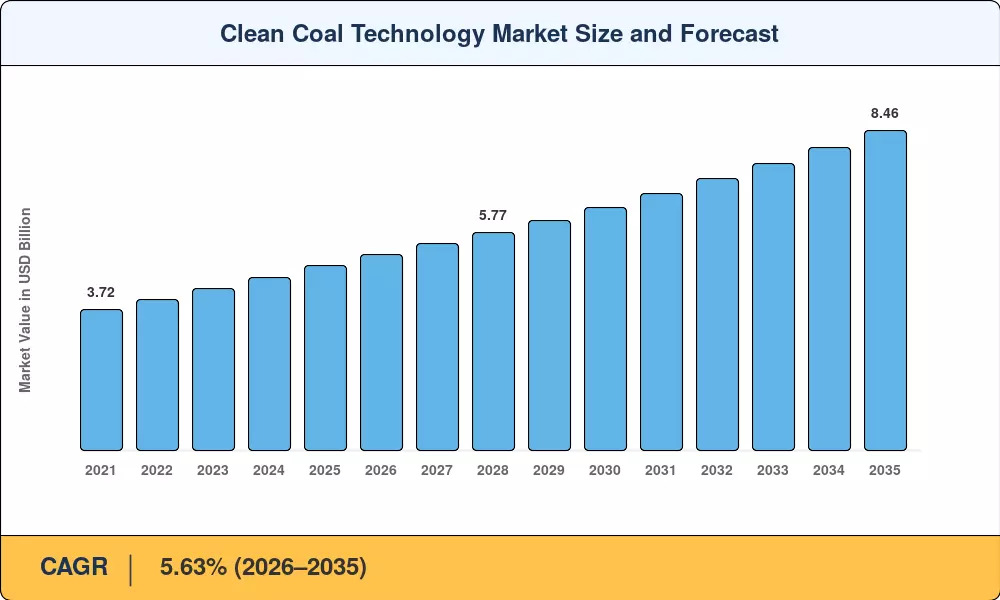
clean_coal_technology_market_description_market_size
Supercritical systems held approximately 47.5% of the Clean Coal Technology Market in 2025, reflecting broad adoption across Asian and European coal fleets.
Equipment accounted for 76.2% of the Clean Coal Technology Market share in 2025, encompassing boilers, turbines, and emissions-control hardware.”
NEW YORK, NY, UNITED STATES, July 29, 2026 /EINPresswire.com/ -- The Clean Coal Technology Market reached an estimated USD 4.89 Billion in 2025 and is projected to grow from USD 5.17 Billion in 2026 to USD 8.46 Billion by 2035, registering a CAGR of 5.63% during the forecast period.— Prashant Hake
Market Overview
Clean coal technology refers to a collection of advanced technologies, processes, and systems designed to reduce the environmental impact of coal-based energy generation and industrial processes. These technologies aim to minimize emissions of pollutants including sulfur dioxide (SO₂), nitrogen oxides (NOx), particulate matter, and mercury, while also addressing greenhouse gas emissions through carbon capture, utilization, and storage (CCUS). Clean coal technologies encompass a broad range of solutions including coal beneficiation and washing, flue gas desulfurization, selective catalytic reduction, integrated gasification combined cycle (IGCC), fluidized bed combustion, and advanced carbon capture systems. These technologies enable the continued use of coal as a significant energy source while aligning with increasingly stringent environmental regulations and climate change mitigation goals.
The clean coal technology market is experiencing steady growth driven by several key factors. The global dependence on coal for electricity generation and industrial processes, particularly in developing economies, creates sustained demand for technologies that reduce the environmental footprint of coal utilization. Government regulations and international commitments to reduce greenhouse gas emissions and air pollutants are compelling coal-fired power plants and industrial facilities to invest in clean coal technologies. Additionally, the need for energy security and diversification of energy sources in many countries supports continued investment in cleaner coal utilization.
Key industry trends shaping the clean coal technology market include the growing emphasis on carbon capture, utilization, and storage as a critical tool for achieving climate goals while maintaining energy security. The development of more efficient and cost-effective carbon capture technologies, including membrane-based separation, chemical looping combustion, and solvent-based absorption, is gaining momentum. The integration of clean coal technologies with renewable energy sources and hybrid energy systems is also emerging as a trend, particularly in regions seeking to balance grid stability with decarbonization objectives.
The market is also benefiting from technological advancements in coal processing and combustion. Innovations such as supercritical and ultra-supercritical boiler technologies offering higher thermal efficiency are reducing coal consumption and emissions per unit of power generation. The development of coal drying technologies, coal water slurry production, and advanced gasification processes is expanding the application scope of clean coal technologies beyond power generation.
Policy and regulatory frameworks significantly influence the clean coal technology market landscape. International climate agreements, including the Paris Agreement, and national commitments to net-zero emissions are driving policy support for clean coal technologies. Government funding for research and development, tax incentives for clean coal investments, and emissions trading schemes are encouraging adoption. The implementation of stringent emission standards, such as the US Environmental Protection Agency's Mercury and Air Toxics Standards (MATS) and the EU Industrial Emissions Directive, mandates the deployment of emission control technologies at coal-fired facilities.
The demand outlook for clean coal technologies remains positive, supported by the long-term role of coal in the global energy mix, particularly in Asia-Pacific regions. The need to retrofit existing coal-fired power plants with emission control technologies in developed markets, combined with the construction of new clean coal facilities in emerging economies, will drive market growth. The increasing focus on coal-to-chemicals and coal-to-liquids applications is also creating new demand for clean coal technologies.
Get Free Sample Report for Detailed Market Insights: https://www.marketresearchfuture.com/sample_request/10012
Market Segmentation
By Technology: The clean coal technology market is segmented into various technology categories including coal beneficiation, coal gasification, flue gas desulfurization (FGD), selective catalytic reduction (SCR), particulate matter control, mercury control, carbon capture and storage (CCS), and other technologies. Flue gas desulfurization holds a significant market share, driven by stringent sulfur emission regulations in major coal-consuming countries. Carbon capture and storage technologies are expected to witness the fastest growth during the forecast period as governments and industries intensify efforts to reduce greenhouse gas emissions. Coal beneficiation technologies remain essential for improving coal quality and reducing ash content prior to combustion.
By Application: The market is categorized into power generation, industrial processes, and coal-to-chemicals applications. Power generation dominates the clean coal technology market, as coal-fired power plants represent the largest source of coal-related emissions and the primary focus of environmental regulations. Industrial applications, including cement production, steel manufacturing, and chemical processing, are significant consumers of clean coal technologies for emission control. Coal-to-chemicals and coal-to-liquids applications are emerging as important segments, particularly in regions with abundant coal resources and limited oil and gas reserves.
By End-User: The market serves various end-user industries including power utilities, cement manufacturing, steel production, chemical processing, and other industrial facilities. Power utilities are the largest end-user segment, accounting for the majority of clean coal technology investments. The cement and steel industries are significant users of clean coal technologies, driven by their substantial coal consumption and emissions profiles.
By Region: The market is analyzed across North America, Europe, Asia-Pacific, Latin America, and the Middle East and Africa. Asia-Pacific dominates the global clean coal technology market, accounting for the largest share due to extensive coal-based power generation and industrial activities in China, India, Japan, and South Korea.
🛒 You can buy this market report at: https://www.marketresearchfuture.com/checkout?currency=one_user-USD&report_id=10012
Regional Analysis
North America: The North American clean coal technology market is characterized by a mature regulatory framework and significant investments in emission control technologies. The United States leads the region, with extensive coal-fired power generation capacity and a strong focus on reducing emissions from existing coal plants. The Clean Air Act and associated regulations have been instrumental in driving the adoption of SO₂, NOx, and mercury control technologies. The US Department of Energy continues to fund research and development initiatives in advanced clean coal technologies and carbon capture. Canada, with its coal-fired power generation in provinces such as Alberta and Saskatchewan, is investing in CCS projects and emission control technologies to meet climate commitments. However, the region faces challenges from the retirement of aging coal plants and competition from natural gas and renewable energy sources.
Europe: Europe represents a market in transition, characterized by declining coal consumption and increasing focus on carbon capture and storage technologies. The European Union's ambitious climate targets and the phasing out of coal in many member states are shaping the clean coal technology market. While overall coal use is decreasing, countries such as Germany, Poland, and Turkey continue to have significant coal-fired power generation capacity. The region is focusing on retrofitting existing plants with advanced emission control technologies and exploring CCS as a tool for decarbonization. The EU's Innovation Fund and other funding mechanisms support clean coal research and demonstration projects.
Asia-Pacific: The Asia-Pacific region dominates the global clean coal technology market and is projected to experience the fastest growth. China, as the world's largest coal consumer and producer, represents the largest market for clean coal technologies. The Chinese government has implemented stringent emission standards and invested heavily in modernizing its coal-fired power fleet with advanced technologies. India is emerging as a significant market, driven by its expanding coal-based power generation capacity and growing environmental awareness. Japan and South Korea, with their advanced technological capabilities, are investing in clean coal technologies including IGCC and CCUS. Southeast Asian countries including Indonesia, Vietnam, and the Philippines are increasing their reliance on coal for power generation, creating growing demand for clean coal solutions.
Latin America: The Latin American clean coal technology market is relatively smaller but presents opportunities, particularly in countries with coal resources such as Colombia, Brazil, and Mexico. Colombia's coal mining industry and growing energy needs support demand for clean coal technologies. Brazil's coal-fired power plants, primarily located in the southern region, are being upgraded with emission control technologies. The region's focus on energy diversification and environmental improvements is expected to drive moderate market growth.
Middle East and Africa: The Middle East and Africa region presents limited but growing opportunities for clean coal technologies. South Africa, with its extensive coal reserves and coal-fired power generation, is the largest market in the region. The country is investing in clean coal technologies, including coal beneficiation and emission control, to reduce the environmental impact of its energy sector. Other African countries with coal resources, such as Botswana and Zimbabwe, represent emerging markets. The Middle East's focus on oil and gas, coupled with limited coal infrastructure, constrains market growth in the region.
Competitive Landscape / Key Players
The global clean coal technology market is characterized by a mix of established energy companies, technology providers, and engineering firms. Key companies operating in the market include:
General Electric Company: A global leader in power generation and clean energy technologies, offering solutions including IGCC technology, gas turbines, and emission control systems for coal-fired power plants.
Mitsubishi Heavy Industries, Ltd.: A Japanese industrial conglomerate providing a comprehensive portfolio of clean coal technologies, including ultra-supercritical boilers, carbon capture systems, and flue gas desulfurization equipment.
Siemens AG: A German multinational company offering advanced power plant technologies including steam turbines, gasifiers, and digital solutions for optimizing coal-fired power generation.
Babcock & Wilcox Enterprises, Inc.: A US-based company specializing in clean coal technologies, including circulating fluidized bed boilers, selective catalytic reduction systems, and wet flue gas desulfurization systems.
Doosan Heavy Industries & Construction Co., Ltd.: A South Korean company providing power generation solutions including ultra-supercritical boilers, carbon capture technologies, and environmental control systems.
Other notable players include Alstom Power, Foster Wheeler AG, Sumitomo Heavy Industries, Ltd., Thermo Fisher Scientific Inc., and numerous regional engineering and construction firms serving local markets.
Strategic developments in the market include technology partnerships, research collaborations, government-funded demonstration projects, and geographical expansion into emerging markets.
Latest Industry News & Developments
December 2025: General Electric announced a breakthrough in carbon capture technology for coal-fired power plants, achieving a 95% capture efficiency with 30% lower energy consumption compared to conventional systems. The technology is expected to reduce the cost of CCUS deployment and make coal-based power generation more compatible with climate goals.
November 2025: Mitsubishi Heavy Industries commissioned a commercial-scale carbon capture facility at a major coal-fired power plant in Japan, capturing 150,000 tonnes of CO₂ annually for utilization in enhanced oil recovery and chemical production. The project represents a significant milestone in the commercialization of CCUS technologies in Asia.
September 2025: The Chinese government announced a $10 billion investment program for the deployment of ultra-supercritical clean coal technologies and carbon capture systems at 50 major coal-fired power plants across the country. The initiative aims to reduce emissions intensity while maintaining energy security.
Market Challenges & Opportunities
Key Restraints: The clean coal technology market faces several challenges that could impact its growth trajectory. The high capital costs associated with advanced clean coal technologies, particularly carbon capture and storage, create significant financial barriers for deployment. The declining cost competitiveness of coal compared to natural gas and renewables in many markets reduces investment incentives. Policy uncertainty and changing regulatory landscapes, including the phasing out of coal in some countries, create investment risks. Technical challenges including the scale-up of carbon capture technologies, the availability of suitable geological storage sites, and the energy penalty associated with capture processes remain significant obstacles.
Emerging Opportunities: The clean coal technology market presents substantial opportunities in carbon capture, utilization, and storage development. The growing interest in CO₂ utilization for enhanced oil recovery, chemical production, and building materials opens new revenue streams and investment incentives. The modernization of aging coal-fired power plants in developed markets offers significant retrofit opportunities. The development of hybrid energy systems combining clean coal technologies with renewables, energy storage, and hydrogen production creates integrated energy solutions. The expansion of coal-to-chemicals and coal-to-liquids industries in coal-rich countries presents new application opportunities.
Future Potential: The long-term potential of the clean coal technology market is tied to the continued role of coal in the global energy mix, particularly in Asia-Pacific regions where coal is expected to remain a significant energy source for decades. The development of more cost-effective and energy-efficient clean coal technologies, supported by government research funding and industry innovation, will enhance market viability. The integration of clean coal with hydrogen production and the development of low-carbon coal-based supply chains offer future growth pathways. Market resilience and the essential role of coal in energy security in many countries ensure sustained demand for clean coal technologies over the medium term.
To explore more market insights, visit us at: https://www.marketresearchfuture.com/reports/clean-coal-technology-market-10012
Final Market Summary
The global clean coal technology market is poised for steady growth, with projections indicating an expansion from USD 5.17 billion in 2026 to USD 8.46 billion by 2035, at a compound annual growth rate of 5.63%. This growth trajectory is driven by the continued reliance on coal as a major energy source, stringent environmental regulations, and increasing investments in emission control technologies. Asia-Pacific emerges as both the largest and fastest-growing regional market, dominated by extensive coal consumption in China and India. Technological advancements in carbon capture, high-efficiency combustion, and emission control are shaping the industry landscape. While challenges including high costs, policy uncertainty, and competition from alternative energy sources persist, the market offers substantial opportunities in CCUS deployment, plant modernization, and new industrial applications. The critical role of clean coal technologies in balancing energy security with environmental responsibility ensures sustained market demand and long-term growth potential throughout the forecast period.
More Related Reports from MRFR Library:
Air Separation Plant Market: https://www.marketresearchfuture.com/reports/air-separation-plant-market-1997
Offshore Supply Vessels Market: https://www.marketresearchfuture.com/reports/offshore-supply-vessels-market-2067
Industrial Air Compressor Market: https://www.marketresearchfuture.com/reports/industrial-air-compressor-market-2075
String Inverter Market: https://www.marketresearchfuture.com/reports/string-inverter-market-2083
Concentrated Solar Power Market: https://www.marketresearchfuture.com/reports/concentrating-solar-power-market-2104
Water Purifier Market: https://www.marketresearchfuture.com/reports/water-purifier-market-2178
Agriculture Equipment Market: https://www.marketresearchfuture.com/reports/agriculture-equipment-market-2182
Bearing Market: https://www.marketresearchfuture.com/reports/bearing-market-2183
Electric Motor Market: https://www.marketresearchfuture.com/reports/electric-motors-market-2376
Thermal Energy Storage Market: https://www.marketresearchfuture.com/reports/thermal-energy-storage-market-2401
Larry Wilson
WantStats Research And Media Pvt. Ltd.
+1 855-661-4441
email us here
Visit us on social media:
LinkedIn
Facebook
YouTube
X
Legal Disclaimer:
EIN Presswire provides this news content "as is" without warranty of any kind. We do not accept any responsibility or liability for the accuracy, content, images, videos, licenses, completeness, legality, or reliability of the information contained in this article. If you have any complaints or copyright issues related to this article, kindly contact the author above.
