

STARCHIUM’s ArchiPilot Presents the Future of AI-Designed Architecture… Drawings in 2 Minutes, Productivity to 28-Fold

CEO Jeongwan Lee of STARCHIUM
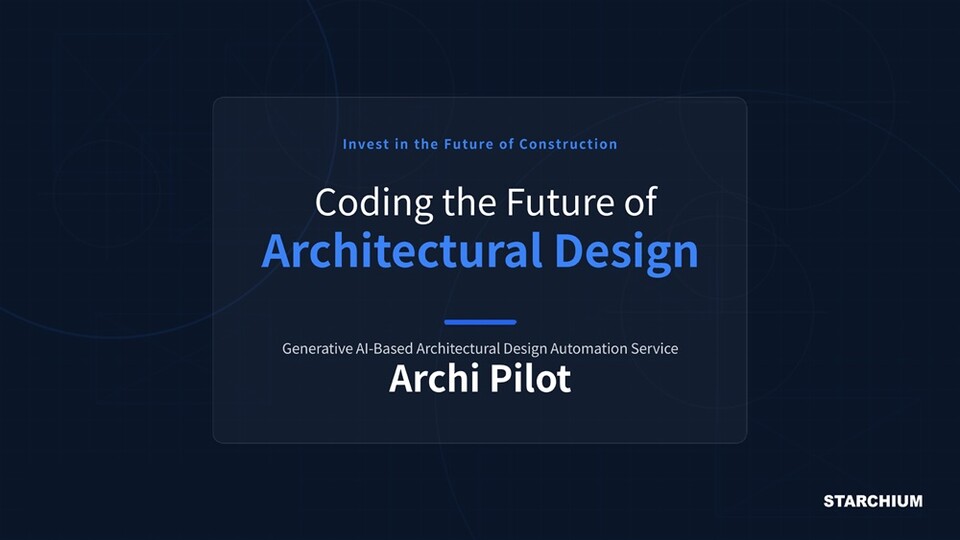
A page from the presentation introducing ArchiPilot, which designs the future of architectural design | Image provided by STARCHIUM
“Our Platform Replaces Manual CAD Drafting with Native Vector Generation, Boosting Design Workflows and Reviews for B2B Construction and Architecture Firms.”
PANGYO, GYEONGGI-DO, SOUTH KOREA, August 20, 2026 /EINPresswire.com/ -- STARCHIUM is an AI technology company founded to drive step-by-step digital transformation across the analog construction sector and has recently drawn significant industry attention by unveiling ‘ArchiPilot’, a generative AI-based architectural design automation platform. STARCHIUM previously operated ‘ZAZERO’, an integrated construction material ordering platform for small- and mid-sized contractors and interior firms. Capitalizing on the data and field expertise accumulated through logistics management, the company is now driving productivity innovation across the entire construction process—from initial site layout design to automated material procurement.Equipped with proprietary Prompt-to-DXF generation technology, ArchiPilot generates native vector (DXF) drawings that architects can immediately view and edit in CAD software within just 2 minutes when users input an address, site conditions, scale, and design requirements via simple natural language prompts. Conventional architectural drafting incurs significant waste of workforce and capital due to endless manual reviews, repetitive drafting of elements, and complex statutory verification processes. In fact, for the Jincheon National Training Center Phase 2 project, 28 specialized personnel worked for 3 months, incurring about 336 million KRW in labor costs; introducing ArchiPilot allows 3 personnel to process the work in 1 month for 12 million KRW, improving labor productivity 28-fold and reducing labor costs by up to 96.4 percent.
This innovative technology has received immediate validation right in the field. In February 2026, during an MVP test with about 40 practicing architects focused on site layout design modules, users showed immediate and enthusiastic reactions. STARCHIUM CEO Jeongwan Lee stated that test participants recognized the platform’s core value within 10 seconds of viewing a demo, noting its ability to streamline workloads and prompting inquiries about immediate B2B adoption. Because architectural blueprints serve as a universal, standardized graphical language, international scalability is exceptionally high; even before formal overseas marketing campaigns, users in international markets, including Canada and the Netherlands, have actively accessed and utilized the platform.
Based on these empirical results, STARCHIUM is accelerating its entry into high-growth global markets, including Southeast Asia, Japan, the US, and the Middle East. Using Singapore as an English-speaking hub, the company plans to identify localized collaboration models, expand its presence to Japan with its highly systematized drafting standards, and target the US and Middle East for long-term, large-scale infrastructure projects. CEO Jeongwan Lee is a Building Information Modeling (BIM) expert with 8 years of field experience, having executed over 10 major domestic and international projects including the National Museum of Qatar and the Incheon Port Cruise Terminal—field know-how that serves as the core foundation for STARCHIUM’s technological refinement.
Furthermore, STARCHIUM accelerates its growth engine from its corporate base in Pangyo Techno Valley. Pangyo offers not only an excellent transportation network but also comprehensive startup support infrastructure provided by Gyeonggi Province and related public institutions. This provides an optimal environment for cross-industry networking and technological collaboration as diverse AI and SaaS enterprises converge. Leveraging the local Pangyo ecosystem, STARCHIUM plans to actively pursue international joint R&D initiatives and strategic B2B partnerships.
Pangyo TV met with STARCHIUM CEO Jeongwan Lee at the Startup Campus in Pangyo Techno Valley to discuss their generative vector interpretation engine, workflow automation, and global expansion strategy. Reporter Thomas Frederiksen conducted the interview.
Q1. Thomas Frederiksen, Reporter: Hello everyone, and thank you for joining us here today at the Startup Campus in Pangyo Techno Valley. I’m here with Mr. Jeongwan Lee from STARCHIUM. Welcome, nice to meet you! Could you tell me a little bit about your company?
A. Jeongwan Lee, CEO of STARCHIUM: STARCHIUM is a company driving step-by-step digitalization across the construction industry. Globally, the construction sector remains largely analog, so we are using AI and digital technologies to transform logistics, architectural design, and construction into digital processes step by step. Our primary services include ‘ZAZERO’, an integrated B2B logistics ordering service, and ‘ArchiPilot’, an automated architectural design service.
Q2. Your company already has ZAZERO as an existing product, and now you have a new product called ArchiPilot. What does ArchiPilot do?
A. Jeongwan Lee: Architectural designers, architects, and interior design professionals have traditionally used CAD software to draw blueprints manually. Because everything was drawn line by line, the entire process—from initial design to revisions—required substantial effort. The architectural design industry is heading toward automation, and ArchiPilot is a generative AI service designed to automate this workflow. Moving forward, designers will be able to generate blueprints using simple conversational prompts. At the same time, statutory compliance reviews and overlapping-element checks will be handled automatically as we continue to develop the service.
Q3. The most interesting feature is that it generates vector files, meaning the content in the file can be edited directly. Why is this vector technology so important for your platform?
A. Jeongwan Lee: Standard raster image files pixelate and lose quality when zoomed in or scaled. In contrast, vector files retain their precision without distortion, which is why they are essential for high-precision industries. CAD graphics are vector-based—they may look like drawings, but they are actually interconnected data structures. Our key innovation is training our AI model to generate actual vector data rather than simple flat images. Because ArchiPilot outputs CAD-compatible vector files, users can download them directly into AutoCAD for immediate editing, retouching, and refinement. Beyond general architecture, once vector-based design automation is established, it can expand into electrical, structural, and civil engineering workflows, as well as shipbuilding and other industrial CAD workflows.
Q4. You can input details such as address, site conditions, usage, scale, and floor counts. What kind of customers would be using this technology?
A. Jeongwan Lee: Our primary target customers are architectural design firms. In South Korea, small architectural design firms account for roughly 80% to 90% of the industry. During initial concept stages, principal architects direct the overall vision. However, converting those ideas into detailed blueprints—such as drawing repetitive elements like restrooms—can now be delegated to AI. Therefore, working architects at small firms are our immediate primary users, followed by interior design firms, general contractors, and real estate developers who frequently review blueprints. Furthermore, because our output is vector data, it can eventually integrate with BIM (Building Information Modeling) to automatically calculate material quantities, schedules, and construction management parameters.
Q5. How far along is the development of ArchiPilot, and what kind of feedback have you received from practical testing?
A. Jeongwan Lee: Planning began in early 2025, and core R&D was initiated in the second half of that year. This year, we focused on the very first stage: site layout design, which involves planning building placement while strictly adhering to zoning codes, coverage ratios, floor area ratios, and height restrictions. We developed an MVP for this module and tested it with approximately 42 practicing architects around February 2026. A brief 10-second demo video was enough for architects to grasp the concept instantly. They recognized that while it drastically streamlines their workload, it also represents a transformative technology for the industry. Many reached out immediately to inquire about implementation and collaboration, confirming strong market validation.
Q6. Looking ahead, what are your plans to expand ArchiPilot into global markets beyond Korea?
A. Jeongwan Lee: The fundamental language of architectural design is not text—it is graphical drawings. Blueprints follow globally recognized standards, making ArchiPilot exceptionally well-suited for international expansion. Speed is critical to capture first-mover advantage. Users in markets such as Canada and the Netherlands have already begun testing our MVP. Our approach varies by region: in rapidly growing markets such as India and Southeast Asia, automated tools help bridge technical skill gaps. Conversely, in mature markets like the US and Japan, which possess decades of accumulated detailing know-how, we are pursuing joint technical developments to integrate specialized local design methods.
Q7. Finally, STARCHIUM is operating here in Pangyo Techno Valley. What are the key advantages of building your company within this specific startup ecosystem?
A. Jeongwan Lee: First, the location and transportation infrastructure are exceptionally convenient. Second, Pangyo Techno Valley was strategically established by Gyeonggi Province and public institutions to foster startups, offering tailored infrastructure and support programs for each growth stage—from early inception to global scaling. Local programs actively bridge operational gaps in business management, HR, and technical execution. Third, being surrounded by fellow startup founders creates strong networking and peer communication. In summary, Pangyo offers excellent accessibility, comprehensive startup support infrastructure, and a strong collaborative network of entrepreneurs.
Kim Seung Yeon
Gyeonggi Business & Science Accelerator
+82 31-776-4834
email us here
Visit us on social media:
LinkedIn
Instagram
Facebook
YouTube
Other
Legal Disclaimer:
EIN Presswire provides this news content "as is" without warranty of any kind. We do not accept any responsibility or liability for the accuracy, content, images, videos, licenses, completeness, legality, or reliability of the information contained in this article. If you have any complaints or copyright issues related to this article, kindly contact the author above.
